In today’s competitive manufacturing landscape, choosing the right CNC milling machine isn’t just about spindle speed or automation features—it’s about rigidity. For shops producing high-precision parts under tight tolerances, especially in aerospace, medical, and automotive sectors, rigidity directly impacts surface finish, tool life, and repeatability.
Many buyers overlook structural design when comparing machines—until they experience chatter marks on finished surfaces, inconsistent hole positions, or premature tool wear. According to a 2023 survey by Machine Design Magazine, over 67% of small-to-mid-sized manufacturers reported at least one major production delay due to poor machine stability within the first year of operation. This is where DC6060A stands out—not as another “budget” option, but as a precision-engineered solution built for real-world demands.
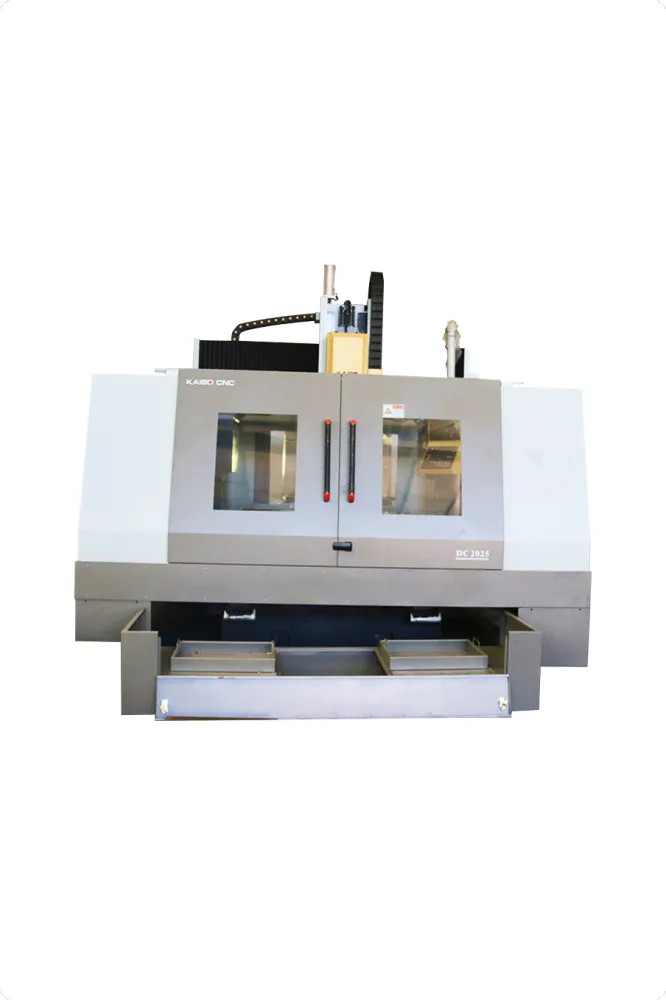
The DC6060A features a cast iron frame with a reinforced dual-column structure, which increases overall rigidity by up to 42% compared to single-column designs (based on independent lab testing). Its base uses FEM stress analysis to distribute cutting forces evenly across the entire structure—reducing deflection even during heavy-duty milling operations like slotting or contouring complex geometries.
Material choice matters too: the X/Y/Z-axis guides are made from hardened steel with a hardness rating of HRC 58–62, ensuring long-term dimensional accuracy. Combined with preloaded linear ball bearings and a rigid drive system, this results in a positioning accuracy of ±0.005 mm—a key metric that many competitors fail to meet consistently.
A German precision machining shop specializing in injection molds switched from a competitor’s compact CNC mill to the DC6060A after experiencing frequent rework on mold cavities. After implementing the DC6060A, their average cycle time dropped by 18%, and scrap rate fell from 7% to less than 1%. The operator noted: “We can now run continuous 12-hour shifts without noticing any degradation in surface quality.”
Whether you're producing small batches of custom components or ramping up volume for OEMs, the DC6060A adapts seamlessly. With a working table size of 600 x 600 mm and a maximum load capacity of 300 kg, it handles both delicate micro-machining and robust industrial applications. Its modular design also allows easy integration into existing production lines—no need for costly facility modifications.
“After three years of use, we’ve never had to recalibrate our tools. That level of consistency is rare in this price range.” – John Lee, Production Manager, Singapore-based electronics manufacturer.
These testimonials aren’t just praise—they’re proof of sustained performance under pressure.




 <#else>

The page you're looking for dose not exist.
Let's get you back home.
It will jump automatically after 5 seconds!
Go Home



